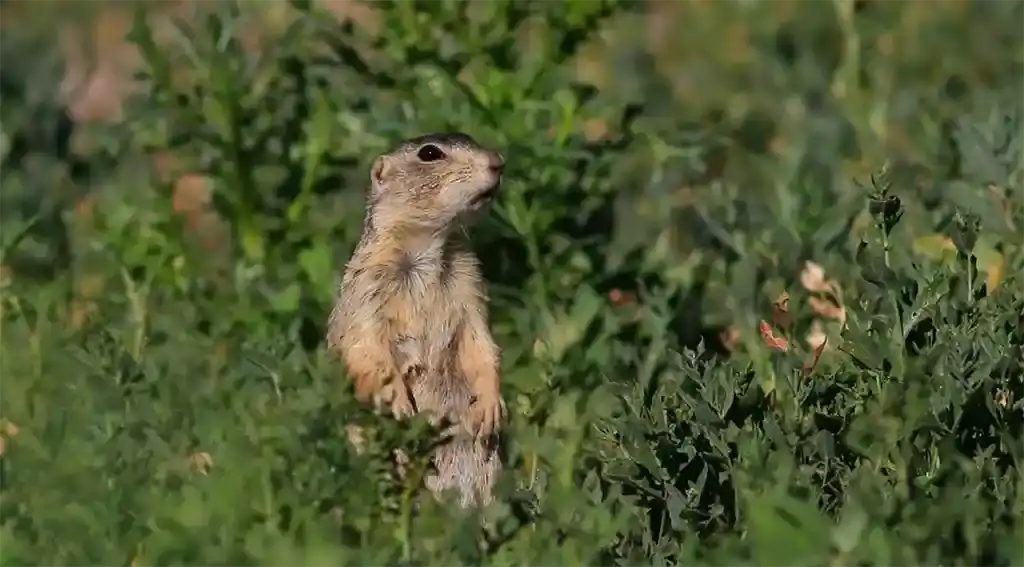
Prairie dogs are a keystone species, which means their existence is crucially important to numerous other species who depend upon them. In New Mexico, Gunnison’s prairie dogs in the north and black-tailed prairie dogs in the south are vital to the overall health of desert, mountain, meadow, and grassland ecosystems between 6,000 and 12,000 feet above sea level.
Prairie dogs, their large underground communities (called “colonies”), and their foraging and burrowing activities provide robust benefits to ecosystems, including vegetation management; spreading seeds, plants, and flowers that attract pollinators; aerating and fertilizing the soil; and acting as a food source for predators. Abandoned prairie dog burrows also provide shelter for other wildlife such as burrowing owls, ferrets, and rabbits. In the United States, less than 1% of the peak prairie dog population survives. Although their species’ population numbers have declined in recent years, it is not uncommon to come across prairie dogs in the wild and, in urban settings, making human coexistence with prairie dogs a particularly worthy goal.
Coexistence best practices include installing barriers to prevent prairie dogs from crossing into certain property, being aware that gardening attracts prairie dogs, maintaining fields, and rotating pastures. If these methods fail, colony relocation by experienced, properly equipped rescuers is the most effective, humane alternative.
In New Mexico, most county and municipal ordinances do not protect prairie dog colonies, although some do prohibit cruelty against prairie dogs. The City of Santa Fe has been a trailblazer in this area—since 2001, their ordinance has required relocation of active colonies before commercial or major development, while also protecting prairie dogs from cruelty.
Santa Fe County is in the process of developing a requirement similar to the city. After an active prairie dog colony was bulldozed in December 2025, Animal Protection New Mexico was contacted by a local prairie dog advocate, who also reached out to the Santa Fe County Commission, copying us on their emailed plea to the Commission to enact such legislation. APNM communicated our support to the Commissioners. In response, Commissioner Hank Hughes introduced—and the County Commission unanimously passed—Resolution 2026-062 to require evaluation, protection, and relocation before development in Santa Fe County. This is not yet local law, but Commissioner Hughes hopes to codify it into the county ordinance before the year’s end.
APNM works closely with other New Mexico nonprofits who are devoted specifically to protecting prairie dogs or colony relocation. For example, Prairie Dog Pals in Albuquerque and People for Native Ecosystems in Santa Fe both perform colony feeding and facilitate colony relocation in their areas. When APNM’s Cruelty Helpline has received prairie dog abuse concerns and reports of development on properties with established prairie dog colonies, our communication and collaboration with these organizations have proven instrumental in helping ensure such concerns are addressed.
For example, in April 2026, a prairie dog colony in Santa Fe County was in the area of a planned traffic circle construction. A coalition of advocates, including People for Native Ecosystems and APNM, persuaded the County to ensure work was paused until the colony could be taken up, quarantined, and then relocated, despite there being no legal requirement to do so. Relocation was accomplished just a few months later.
In another instance, APNM received a complaint on our Cruelty Helpline about possible prairie dog abuse at a park in Santa Fe, but while researching the complaint, we learned that it was the relocation contractor filling burrows with soap suds while gathering the colony for relocation. We relayed this comforting information to the Helpline caller. These prairie dogs have also been relocated, another example of the good communication and cooperation between prairie dog advocates, APNM, and the City of Santa Fe.
These victories are heartening, but the outlook for prairie dogs statewide is not as rosy. To date, the City of Santa Fe is the only jurisdiction where prairie dogs are protected from cruelty and development in the local ordinance. The more counties and municipalities that join Santa Fe, the better it will be for the prairie dog population—but other than Santa Fe County, we are not aware of any jurisdictions considering enacting such protections. We encourage New Mexicans concerned about prairie dogs in their communities to contact their local government and push for ordinance change.
Even in the City of Santa Fe, where prairie dogs are protected by law, advocates have reported incidents of cruelty and colony damage. At a recent city-sponsored event, attendees were reportedly advised to park in an area housing the oldest existing prairie dog colony in the city, destroying burrows and possibly injuring or killing prairie dogs within.
Misinformation and misunderstandings about prairie dogs continue to be issues as well, so APNM continues to educate folks about prairie dogs and their importance to the ecosystem, while promoting coexistence with this keystone species and other wildlife across our state. You can do your part by speaking up for prairie dog protection: explore our website to find prairie dog information and share it with your community and local leaders. Every voice matters for these intelligent, social, ecologically important animals.