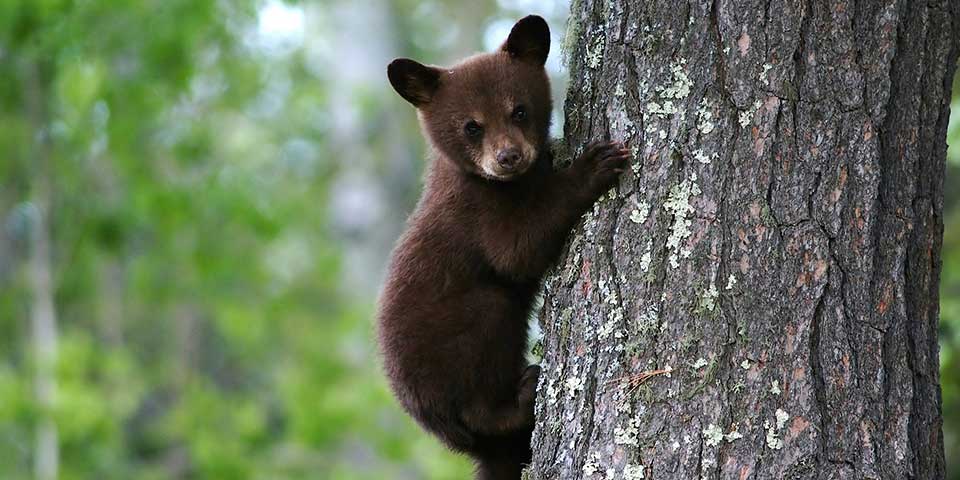
The black bear (Ursus americanus) is New Mexico’s official state animal, and it is the only bear species that calls New Mexico home today. The New Mexico black bear is also very important to the state’s ecosystem, supporting biodiversity through seed dispersal, insect control, and carrion provision.
Yet, despite the special role of black bears in New Mexico, these bears don’t receive any special protections. Black bears are a hunted species, and the state issues hundreds of kill permits each year. Additional bears are killed annually as a result of vehicle collisions, conflicts with agricultural interests, and other human causes.
Several thousand black bears remain in mountain and wooded areas across New Mexico. That’s not a large number, given that bears reproduce slowly. Due to our drier climate, bears tend to start reproducing later in life than bears in northern states. Female bears often don’t have their first cub until they are almost six years old, and then only have one to three cubs every few years.
Despite their name, black bears come in several colors: cinnamon, reddish, blonde, and brown, as well as black. They are naturally shy and non-aggressive unless provoked, startled, or defending their cubs. They feed mostly on plants, and sometimes small rodents and carrion. They can climb trees, swim well, and run up to 35 miles per hour. Black bears are most active from mid-April through mid-November.
FUN FACT:
Smokey Bear was a New Mexico Black Bear
The living symbol of “Smokey the Bear,” the American icon of wildfire prevention, was a three-month old black bear cub found in 1950 after a large forest fire in New Mexico’s Lincoln National Forest near Capitan, NM. The cub had climbed a tree to escape the blaze, but his paws and hind legs had been burned. A New Mexico ranger cared for the little bear until he was flown to the National Zoo in Washington, D.C. He then became the living face of Smokey Bear, the cartoon character invented by the U.S. Forest Service at the end of World War II. Over the years, Smokey Bear received millions of visitors and letters from across the country. After his death in 1976, his adopted son—another orphaned bear cub from the Lincoln Forest—took over the role of Smokey Bear. The original Smokey Bear is buried in Smokey Bear State Park in Capitan.
Sharing the Land with Bears
As the Southwest endures ongoing drought conditions, wild food and water sources are more easily depleted. This means that wildlife, including black bears, need to roam farther in search of sustenance. Bears have one of the keenest senses of smell in the animal kingdom and can detect food from miles away. Abundant high-calorie food sources provided by humans—such as trash, birdseed, and fruit trees—can be very tempting to hungry bears.
The saying “a fed bear is a dead bear” means that bears who become habituated to humans are more likely to get into conflicts with people—and the bears pay the price. Help keep both bears and people safe by not attracting them to your environment and preventing unwanted encounters.
Hiking with Bears
Close encounters with bears are rare. Black bears are wary of people and will usually try to avoid us if they can. Their normal response to any perceived danger is to run away.
- Never approach a bear (and don’t let your dog approach).
- If you see a bear, maintain a safe distance and alter your route to avoid the bear. Never block a bear’s travel route.
- Make noise; don’t surprise a bear.
- If a bear is close, face the bear (without making eye contact) and back away slowly. Talk calmly to identify yourself as a human. Group together and pick up small children and companion animals.
- Do not run.
- If a bear approaches you, scare them away by making yourself as large and imposing as possible by stretching your arms overhead and making loud noises.
- Watch for cubs and stay away from them. Do not come between a mother and her cubs.
- If attacked, fight back aggressively.
- Carry bear spray. Learn how to use it safely. Check the expiration date before heading out.
- Don’t attract a bear by leaving food or trash on the trail.
Camping with Bears
When we relax in the great outdoors, it is important to remember that we are visitors in the bears’ home. Respect bears by not inviting them into your camp.
- Clean and store cooking equipment, and do not leave food or garbage out when not in use.
- Be sure to store food, garbage, or anything that has a scent in a bear-resistant canister at a safe distance from your camp (100+ feet away). Alternatively, hang food/trash securely from a tree, suspending the bag at least 15 feet off the ground, 10 feet out from the tree trunk, and 6 feet below the branch. Use airtight containers to seal in odors.
- Keep your tent and sleeping area scent-free.
- Carry bear spray. Learn how to use it safely. Check the expiration date before heading out.
Living with Bears
Many of our state’s human-populated communities—including Albuquerque, Santa Fe, Los Alamos, Ruidoso, and Raton—are in bear country. If we want bears to survive and thrive, they need our help.
Prevent bears from feeding on your garbage:
Signs of bear activity in your neighborhood include overturned trash cans. You can prevent further bear visits by bear-proofing your garbage.
- Keep your garbage stored in a sturdy shed or closed garage, hidden from view.
- Use a tight-fitting latch, ideally two, to keep a shed door firmly closed.
- For the best protection, use wildlife-proof trash cans that are also rated bear-resistant, with locked and reinforced lids.
- Contain your garbage until the morning of pickup. Don’t put trash cans out the night before.
Remove food sources from your yard:
Make your yard uninteresting to bears, especially if you live close to the mountains and have seen signs of bear activity.
- Keep barbecue grills clean or stored inside.
- Don’t feed companion animals outside.
- Hang bird feeders and hummingbird feeders from wires 10 feet off the ground and 10 feet away from anything a bear can climb. Bring feeders inside at night.
- Consider removing feeders when bears are active (mid-April through mid-November), putting them out only in winter and early spring—when birds need them most.
- Plant fruit trees away from your house, pick fruit as it ripens, and remove fallen fruit.
- Keep compost away from the house and avoid adding melon rinds or other fragrant fruit, except in winter.
- Protect beehives and chicken coops with electric fencing and place them at a distance from your house.
- Don’t leave anything edible in your car overnight if it is parked outside.
If you see a bear…
- Simply sighting a bear from a distance is not cause for alarm. They live alongside us and are likely just passing through.
- If you see a bear nearby, or if a bear is in a nearby tree, walk away or go inside your house, and take your companion animals with you. Give the bear time to leave.
- If a bear comes close to your home, yell at them and make noise from the safety of your doorway. Teach bears that they are not welcome around your home.
- A bear may be a threat to public safety if the bear approaches or follows a person despite deterrence efforts or appears aggressive or tries to enter an occupied structure. Anyone who sees a bear that may be a threat to public safety is urged to call New Mexico State Police Dispatch at (505) 841-9256 to request assistance from a Department of Wildlife Conservation Officer. In case of emergency, call 911.
DID YOU KNOW?
Bears are the largest animals to hibernate, and they do it differently than other species. They stop all activity and drastically slow their metabolism, but they largely maintain their body temperature. This is unusual: other mammals that shut down for the winter also cool down. When humans are inactive for a prolonged time, such as in a hospital bed or suspended in a space station, we can be kept artificially warm, but our muscles wither and our bones get thinner. Bears have no such problems: they can suppress the genes involved in bone breakdown. Similarly, when humans suffer a stroke, our brain may be damaged by insufficient supply of oxygen and nutrients. Bears, on the other hand, can slow their breathing and heart rate by 75%, yet emerge from their winter dens healthy.